

A Meta engineer who helped ship products used by billions of people spent three months preparing for Google’s AI interview, and still failed twice.
His routine remained the same every day. Every morning, he practiced on LeetCode. Every weekend, he designed system mocks. Every night, he took notes on transformer architecture until he could explain attention mechanisms from memory.
The preparation was textbook-perfect. And yet, the rejection emails kept coming.
Not because he wasn’t qualified — but because he was preparing for the wrong interview.
Across Blind, Reddit, and Glassdoor, the same pattern has been showing up since 2025. Engineers rejected by Anthropic, OpenAI, and Google are rarely underqualified. They’re simply preparing for a different evaluation than the one being run.
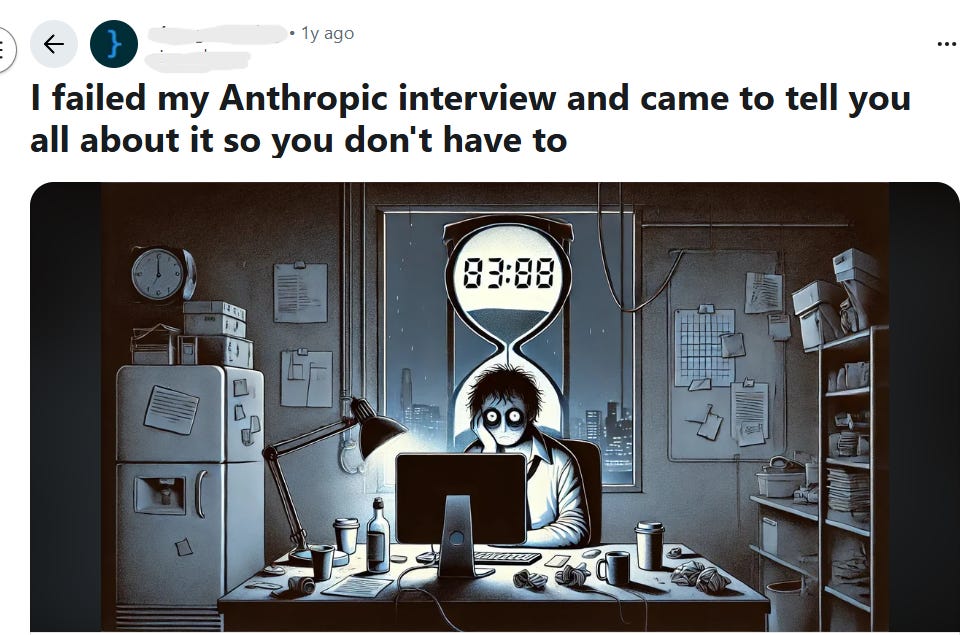
I failed my Anthropic interview and came to tell you all about it so you don’t have to
Most engineers I speak to are terrified of the coding round. That’s not what ends them. The onsite is where strong candidates fall apart.
Here’s why:
• They test how you reason about AI in production, not just how you code
• Safety intuition is evaluated as a hard signal, not a soft “nice-to-have.”
• One weak answer on AI mission alignment can end an otherwise strong candidacy
• Anthropic engineers take home between $471K and $890K — the numbers are right here. The preparation bar needs to match that.
Most candidates sail through every technical round. Then they fail the final one. They want to know what you’d refuse to build. Most engineers have no answer.
The guide every engineer wishes they had before walking in.
Read the AI Engineer Job Guide before your next interview round.
Everyone Told You to Practice LeetCode. That’s the Problem.
A friend sent me a Blind post that night, and one line got me:
“Pretty ironic that if you use AI to study for an AI company, you will fail.”
The chosen engineers truly understood how AI functions in production without reading the few engineering blogs available on the internet.
After interviewing engineers for eighteen years, the most impressive candidates hardly ever had the best responses.
That’s what companies like Anthropic, Netflix, JP Morgan, and Goldman Sachs actually evaluate.

I covered this in my recent video. Three things most engineers never see:
AI doesn’t fail in the model. It fails in the layer nobody thinks about.
The clearest answer beats the smartest answer.
Shipping AI requires a different skill set than building AI.
Here’s what I think is breaking:
Prepping with AI for an AI interview — AI tools often make answers more complex. Frontier Labs rewards clarity and simplicity.
Building to impress, not to explain — The engineers who got in didn’t have the best answer. They had the clearest one.
Memorising answers instead of thinking — They don’t want to hear how Uber solved a problem; instead, they want to watch how you think in the room.
You had been ready, but not for the interview that was going to be conducted. That is precisely what they test.
What happens when AI-generated code fails?

It was midnight, and I was still tangled up with my AWS server. Setting it up for my site had been on my to-do list way too long. Honestly, there were so many dependencies, and I was running on nothing but a strong cup of coffee.
So, I did what every developer does now: I asked ChatGPT for help.
It fired back five different solutions, and “be careful, this might delete your files” warning signals. But once you see shell commands, your brain goes on autopilot, and your fingers just start copying and pasting.

The next morning, I had to rebuild from scratch. Coffee went from optional to absolutely necessary, pretty much the only thing keeping me functional.
So, who do you blame here? Me, or the AI?
For years, I kept seeing junior developers dropping AI-generated code straight into production without reviewing it, stating, “it worked on my machine.” When it didn’t work, they gave the same excuse: “That’s not my code. GPT did it.”
AI is just a tool. You’re still an engineer. If you paste that code and merge it into the main one, it’s yours.
Satya Nadella says more than 30% of Microsoft’s code comes from AI now. Sundar Pichai says Google is at 25%. Stanford found that when developers use AI, their code actually gets less secure, even though they feel more confident.
Anthropic gets it. So when you’re in the final interview round, they’re not grilling you on system design. They’re asking you something most engineers haven’t even thought about:
“When AI wrote the code, and it broke in production, who owns that?”
Here’s what that round actually tests.
The ones who got the job had already figured this out before they walked in for the interview. The others didn’t get the offer.
If you haven’t thought about this yet, start here.
Rejected by Anthropic. Came back 6 months later. Here's what changed.
After the rejection, he didn’t bother updating his LinkedIn. He just sat, disappointed, for a bit. Then, instead of jumping back into preparation guides, he started digging through every real Anthropic interview story he could find. Not the polished advice threads, the raw ones.
One post hit him hard. An engineer who’d made it to the final round broke down every single question, every answer, and the exact moment the conversation went sideways.
That post made him rethink everything.
He stopped obsessing over getting the “right” answer. Instead, he tried to figure out what Anthropic actually cares about:
Read their Constitutional AI paper
Built a little project using their API
Practiced explaining tough concepts
So when the accountability question came up in his next interview, he didn’t panic. He’d been thinking about that question for weeks.
He got the offer.
Then he wrote it all down.
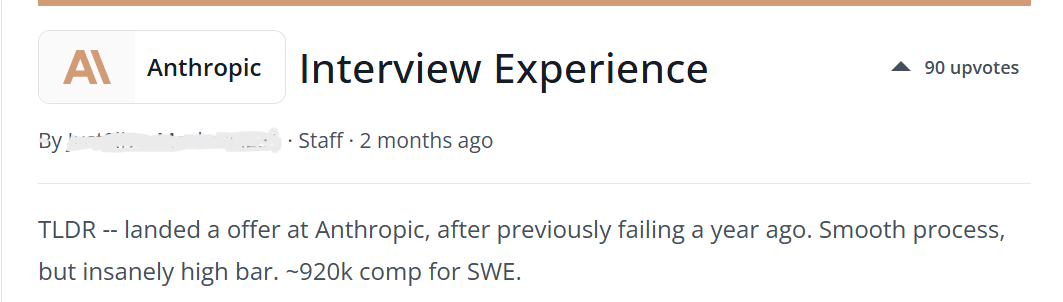
Right away, people reacted. “Finally, someone said it.” “This is the only honest breakdown I’ve seen.”
Most engineers will just read this, bookmark it, and go back to LeetCode. But a few will actually follow that link right now.
210,000 people read this every week. Most of them found it one week too late.