

Your banking app probably sent you a notification last week, as it did for me.

You spent 30% more on food this month.
You felt that familiar guilt, cut back on eating out, cooked a meal on Sunday, and told yourself you were finally getting better with money.
But what if I told you that decision was never yours to begin with? An AI Model made it before you even felt the guilt.
That is the strange part about modern finance.
Most people still imagine AI in banking as something distant. However, trading bots are live on Wall Street. Even a no. of Quant firms are running black-box strategies somewhere behind closed doors.

But AI already sits inside the financial products people use every day.
Your budgeting app studies behavioral patterns. Your bank predicts fraud before you notice the transaction. Your investment platform adjusts your portfolio automatically when markets shift.
And none of these systems are simply observing you. They are making decisions continuously.
From budgeting app to bank, AI is already running the show
Most people think of AI as something that is yet to come, a headline they will deal with later. But they are already in!

Apps like Cleo, Monarch Money, and YNAB do not just track spending. They model habits. They help to identify our overspending cycles, detect emotional triggers, and deploy nudges at moments statistically likely to change behavior.
That feeling after seeing your grocery spending spike? Because someone built it to feel that way.
Robo-advisors like Betterment and Wealthfront work the same way, just with bigger stakes. An algorithm picks the investments, adjusts the risk level, and adjusts the portfolio based on live market data. Do you know the data robo-advisors globally handle? Over 2.7 trillion USD in assets, with every single allocation decided by a machine.
Fraud detection is no different. The moment Visa or Mastercard blocks a suspicious transaction, a model has already compared it against thousands of similar cases and made a call in milliseconds.

In the last issue of Smart SaaSy Tues-De, I looked at how 93% of employees are feeding sensitive data into AI tools without knowing where it goes or who can access it.
AI Finance has not always been Neutral...
Fair… Transparent… Private.
Those are the three promises financial technology keeps repeating. But these are also those areas where these systems have struggled the most.
AI has been running financial tools for years, and these systems have not always made fair decisions. The data they learn from already contains decades of biased lending patterns, and the models learnt those same problems.
The Brookings Institution found that even something as simple as a zip code can help algorithms discriminate without directly identifying who is being targeted.
The explainability problem sits right next to it. When a model rejects a loan or freezes an account, it rarely tells anyone the reason behind.
The reasoning sits inside layers of computation that even the engineers who built the system cannot fully interpret. This means the person on the receiving end has no real way to understand what went wrong or push back against it.
Privacy sits underneath all of it. Every transaction, every spending pattern, every financial habit fed into these systems becomes data that keeps training the model. Whereas the rules meant to protect that data are still being written, while the technology keeps moving forward.
I sat down with Dr. Eva Marie, former CTO of AI at IBM and advisor to the UN and UNESCO, to understand how AI systems actually handle personal data, where the risks sit that most people never hear about, and what consumers should be doing differently right now.
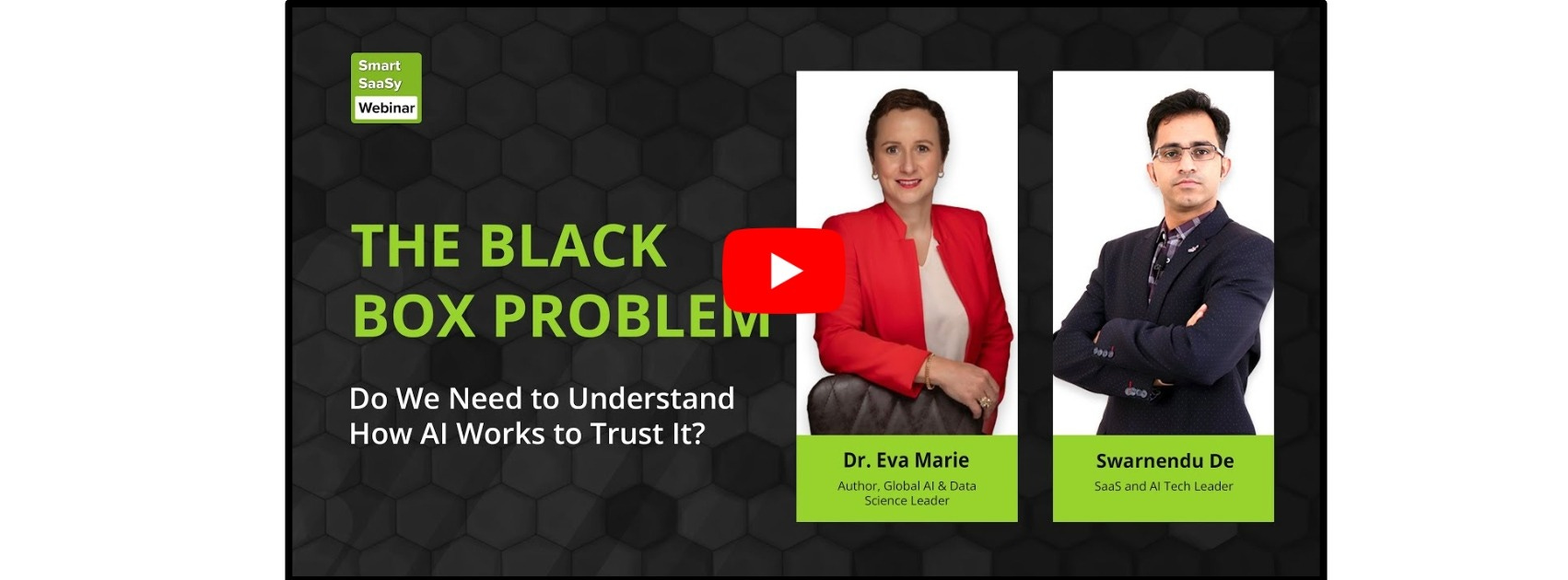
Quick Snippet from my Interview with her:
7:54 — How financial data was profiling people before AI became mainstream
13:49 — Why most large language models are theoretically not GDPR compliant
24:22 — What consumers should actually stop sharing with AI tools right now
Understand the System is the Only REAL advantage left
The shift is no longer limited to banking.

The same decision layers now sit inside SaaS platforms, healthcare systems, insurance products, hiring software, enterprise workflows, and modern GTM engines.
Very few stopped to ask what those systems are like, who is actually optimizing underneath. Because every AI-driven product eventually inherits the assumptions built into its architecture.
What gets prioritized
What gets surfaced
What gets ignored
What gets automated
And in most organizations, leadership teams still cannot fully explain how those decisions are being made at scale.
That gap is becoming one of the biggest operational risks in modern SaaS and AI products.
This is exactly where we spend most of our time at Insightstap. Not simply helping companies “add AI.”
But helping them architect AI systems, GTM workflows, and product ecosystems that remain scalable, explainable, compliant, and commercially viable long term.
The companies that win over the next decade will not be the ones deploying the most AI.
They will be the ones who understand the decision layer underneath it better than everyone else.
If this challenges your current thinking, stay with me.
The point about AI moving from observation into active decision-making is especially important. As more finance workflows become automated, explainability and operational visibility become critical, particularly in areas where payment decisions, risk assessments, and customer interactions directly affect trust and financial outcomes.